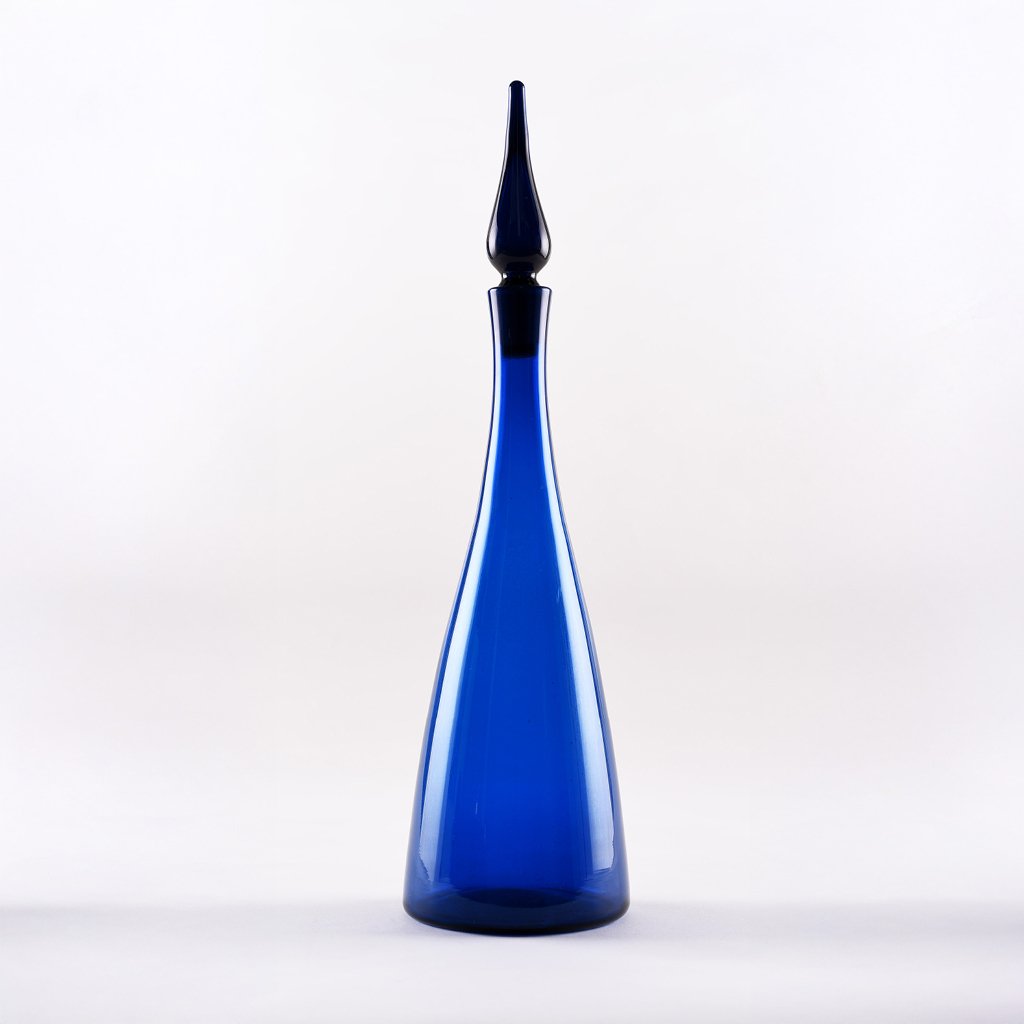
A native of Plymouth, Massachusetts, Anderson served as a topographic draftsman in the United States Army during World War II. He then studied industrial ceramic design at the New York State College of Ceramics at Alfred University. Upon graduating in 1947, Anderson became the first full-time resident designer at the Blenko Glass Company, hired to design modern utilitarian glass vessels for production in the factory. His keen understanding of form and color quickly led to award-winning, highly collectible glass designs that raised the profile of the company. Anderson’s bent decanter and other signature glass designs were featured in the Museum of Modern Art’s “Good Design” exhibition series, an annual celebration of new, thoughtfully designed home furnishings. In 1953, he became the designer and design director for the Lenox China and Crystal Company in Trenton, New Jersey, where he worked until 1980. After retiring, Anderson returned to Milton, West Virginia.
Anderson figures prominently in the Huntington Museum of Art’s story. He was a dear friend to a generation of former employees. Anderson and admirers of his work have enriched the Museum’s permanent collection with numerous gifts of colorful glass, paintings, mechanical drawings and illustrations for his glass designs, and more. A discerning collector, upon his passing in 2007, the Museum received a bequest of 160 works of Haitian art, which was a source of great joy and artistic inspiration, and a generous endowment that primarily supports the expansion and conservation of this important Haitian art collection.
Today’s stewards of Winslow Anderson’s artistic legacy did not know him, but they have heard many stories told by those who did, and he is remembered with great love. Titled simply, eponymously, this exhibit is dedicated to those who knew Winslow.
This exhibit is presented with support from The Isabelle Gwynn and Robert Daine Exhibition Endowment.
This program is presented with financial assistance from the West Virginia Department of Arts, Culture and History, and the National Endowment for the Arts, with approval from the West Virginia Commission on the Arts.