Please join us for the opening reception for this exhibit on Tuesday, July 28, 2026,
from 6 to 8 p.m. Admission to this 4 th Tuesday Tour Event is free. Dr. Joseph B. Touma will lead a Gallery Walk and sign copies of his book, which is available in the Museum Store and features artwork from this exhibit.
The Mamluk Sultanate was a mighty and influential Islamic state that ruled Egypt, the Levant,and the Hejaz from 1250-1517.
Mamlūk is an Arabic word meaning “one who is owned.” In the Mamluk Sultanate, power was maintained through a system of military slavery that produced elite armies of formerly enslaved men who were highly disciplined and fiercely loyal to the sultan.
In the mid-13 th century, the Mamluks seized the fertile floodplains of Egypt and established control of the Levant, a geographic region along the eastern shores of the Mediterranean Sea,
which included modern-day Syria, Lebanon, Jordan, Israel, Palestine, Cyprus, and part of Türkiye. The Mamluk realm also encompassed the Hejaz, a geographic region along the western coast of the Arabian Peninsula, which included part of modern-day Saudi Arabia. For more than
two and a half centuries, the Mamluks controlled these strategically important lands, home to cities with great religious significance, such as Bethlehem and Jerusalem, located in the Southern
Levant, and Mecca and Medina, in the Hejaz.
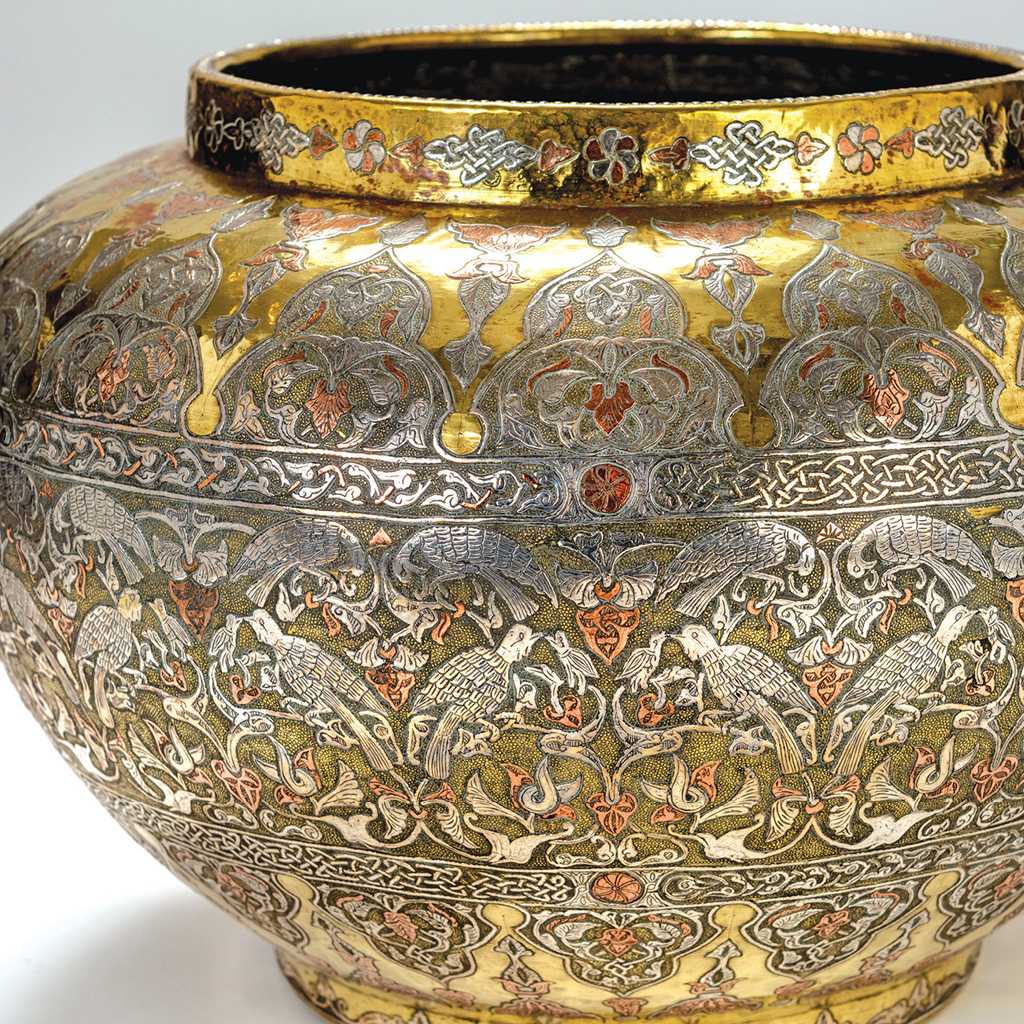
Having halted the invading Mongols and expelled the last Crusaders from the Holy Land, the Mamluks presided over a remarkably stable and prosperous era. Consequently, art and architecture flourished. In Cairo, Egypt, which was among the world’s most populous cities, and Damascus, Syria, one of the oldest, continuously inhabited cities, skilled artisans refined methods for engraving and inlaying metal objects with gold, copper, and silver – a technique called damascene. This dazzling metalwork became a distinctive artistic tradition in Mamluk society, prized by wealthy patrons far beyond the region, but production declined after the Ottomans conquered the Mamluk Sultanate in 1517.
By the late 19 th century, there was a movement to preserve decorative arts from the Mamluk period, and a market emerged for modern interpretations created in the style of those historical objects. In the Shadow of the Mamluks celebrates this revival with an array of remarkable
objects curated from the Touma Near Eastern Collection at the Huntington Museum of Art. The exhibit is a powerful testament to the importance of cultural heritage, as well as the generous spirit and enduring legacy of Drs. Joseph B. & Omayma Touma and family.
This exhibit is presented with support from The Isabelle Gwynn and Robert Daine
Exhibition Endowment.
This project is supported with financial assistance from the West Virginia Department of Tourism and the National Endowment for the Arts, with approval of the West Virginia Commission on the Arts.